Corporate

Grupo Argos began 2026 with solid operational performance across its construction materials, concessions, and real estate businesses, which partially offset the impact of elevated energy spot prices during the first two months of the year. This affected the results of Celsia and weighed on the group’s consolidated financial results for the quarter. This trend began to improve in March and has continued to show better momentum throughout April and May.
Cementos Argos increased its EBITDA, Odinsa maintained growth in road and airport traffic, and the Urban Development Business strengthened its cash generation. These results demonstrate the strength of the portfolio and the company’s ability to continue advancing its agenda of efficiency, value generation, and value transfer.
“The first-quarter operating results confirm the quality of our businesses and the strength of a transformation that has left Grupo Argos with a simpler structure, a focused portfolio, and assets in sectors that are essential for development. Our task now is to accelerate execution, deepen efficiency efforts, reduce debt, strengthen business profitability, and make the portfolio’s value more visible to our shareholders.”
Juan Esteban Calle
Grupo Argos CEO
As part of Grupo Argos’ value generation and value transfer agenda, in March the Shareholders’ Assembly approved a new share repurchase program of up to COP 500 billion to be executed over the next three years. This mechanism, which will begin operating tomorrow, May 15, is based on the conviction that there is a significant gap between the company’s market share price and its fundamental value, and represents the first in a series of initiatives that Grupo Argos has been structuring to help close that gap.
This coordinated plan, which will be shared with the market in greater detail in the coming weeks, aims to increase share liquidity, strengthen shareholder return mechanisms, and make the value of its portfolio more visible, while incorporating lessons learned from Cementos Argos’ SPRINT program.
Cementos Argos reported revenues of COP 1.2 trillion during the first quarter of 2026 and EBITDA of COP 270 billion, representing a 5% increase compared to the same period last year. This performance reaffirms the company’s resilience and its ability to capture efficiencies in a demand environment that continues to present challenges in certain markets. Cement volumes reached 2.1 million tons, up 4%, while concrete volumes totaled 570,000 cubic meters, growing 9% year over year. Cementos Argos continues to advance the separation between Argos Materials — the platform for its reentry into the United States — and Argos Latam, with the objective of maximizing growth potential, strengthening strategic flexibility, and accelerating value creation.
Celsia reported revenues of COP 1.3 trillion during the quarter and EBITDA of COP 363 billion, representing year-over-year declines of 12% and 21%, respectively. These results were primarily explained by lower energy commercialization prices in a context of high hydrology during the first two months of the year. The company remains focused on reducing net debt by approximately COP 1.0 trillion by the end of 2026, further simplifying its corporate structure, and advancing operational efficiency initiatives aimed at strengthening profitability, with the goal of increasing the EBITDA margin of its energy services business by 1,000 basis points over the coming years. Celsia also aims to reduce its operating expenses by more than COP 74 billion during 2026 and achieve a cumulative reduction exceeding COP 150 billion compared to the 2024 baseline. In line with this strategy, in April the company closed the sale of six small hydroelectric power plants in Valle del Cauca, with a combined capacity of 12.6 MW. The proceeds from the transaction were allocated to debt reduction.
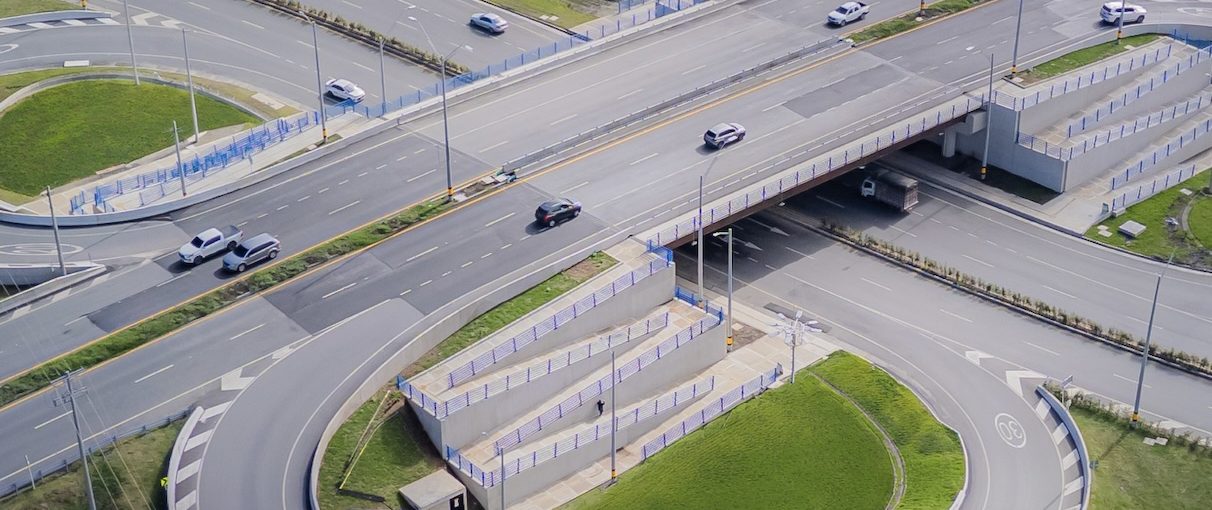
Odinsa reported revenues of COP 117 billion during the first quarter, down 10% year over year, EBITDA of COP 94 billion, declining 14%, and net income of COP 84 billion, 15% lower than the previous year. This decrease was mainly due to the fact that 2026 did not include the exceptional valuation gain recorded in 2025 from the incorporation of the second phase of the Oriente Tunnel. Odinsa Roads mobilized 10.4 million vehicles and reached an average daily traffic of nearly 116,000 vehicles, while Odinsa Airports recorded total traffic of 13.3 million passengers, of which 12 million corresponded to El Dorado International Airport, representing year-over-year growth of 10%. In this new phase, the company is focused on financing strategic private initiatives aimed at improving the country’s connectivity and competitiveness, as well as optimizing and increasing the efficiency of its operations. In line with this objective, Odinsa implemented adjustments to its organizational structure and expense base, through which it expects to achieve a reduction of more than 30% in SG&A expenses during the second half of 2026.
The Urban Development Business reported revenues of COP 29 billion during the first quarter, representing growth of 39% compared to the same period last year. In cash flow terms, cash flow revenues increased by 49%, while gross cash flow reached COP 30.5 billion.
Summary of Financial Statements
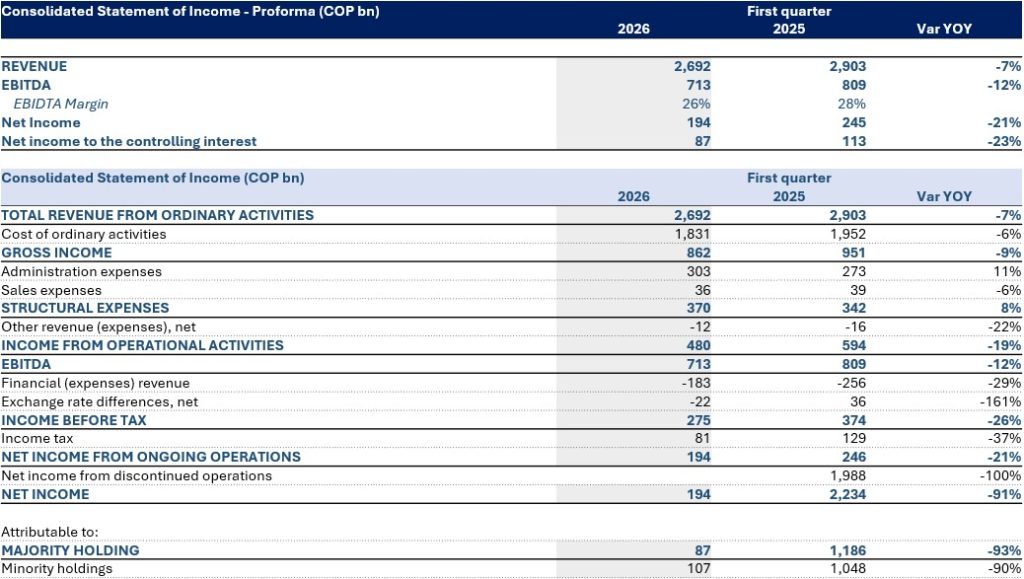
For the first quarter of 2026, Grupo Argos did not record any non-recurring effects in its consolidated results. Therefore, comparisons with the same period of 2025 should consider that the prior-year quarter included extraordinary effects associated with Cementos Argos’ divestment of its stake in Summit Materials and the Spin-Off Merger Project with Grupo Sura, transactions that generated discontinued earnings of nearly COP 2.0 trillion.
During the first quarter of 2026, Grupo Argos reported consolidated revenues of COP 2.7 trillion, down 7% versus the comparable base from the first quarter of 2025. This decrease was primarily explained by lower revenues from energy commercialization in a context of higher hydrology and lower energy prices during the first two months of the year.
EBITDA totaled COP 713 billion, decreasing 12%; net income reached COP 194 billion, down 21% year over year; and controlling net income totaled COP 87 billion, 23% below the previous year.
From an operational standpoint, the cement and real estate businesses contributed an increase of COP 18 billion in EBITDA for Grupo Argos, partially offsetting the COP 95 billion contraction recorded in the energy business. Excluding the impact of the energy segment, consolidated EBITDA would have remained stable year over year, with a variation of 0.1%.
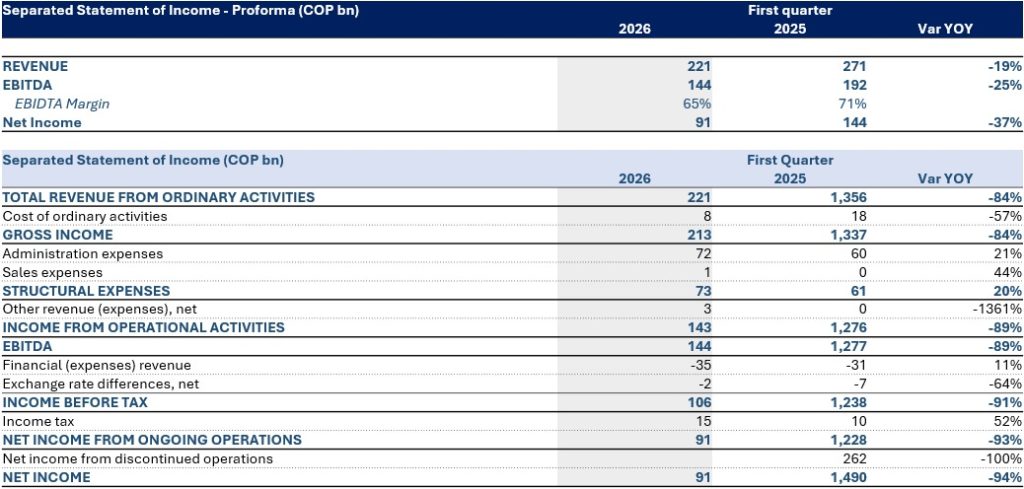
In the separate financial statements, the comparison against the first quarter of 2025 should also consider equity method income exceeding COP 1.0 trillion associated with Cementos Argos’ divestment of its stake in Summit Materials. Excluding this effect, during the first quarter of 2026 the company reported separate revenues of COP 221 billion, representing a 19% year-over-year decrease.
Even so, Grupo Argos maintained strong margins: gross margin reached 96.5%, EBITDA margin stood at 65.2%, and net margin reached 41.3%. Separate net income totaled COP 91 billion, down 37% year over year, mainly explained by a lower contribution from the equity method and by the increase in property taxes associated with the Urban Development Business in Barranquilla.
With these results, Grupo Argos reaffirms the clarity of its roadmap in this new phase. The company has businesses that continue to deliver positive operational dynamics, a clear agenda focused on efficiency and optimization, active value transfer mechanisms, and investment opportunities exceeding USD 5.0 billion in sectors that are essential to the region’s economic development.
Based on this foundation, the company’s priority will be to execute with operational excellence, strengthen financial flexibility, and continue advancing toward an increasingly focused and profitable structure to support growth and increase value transfer to its shareholders.